

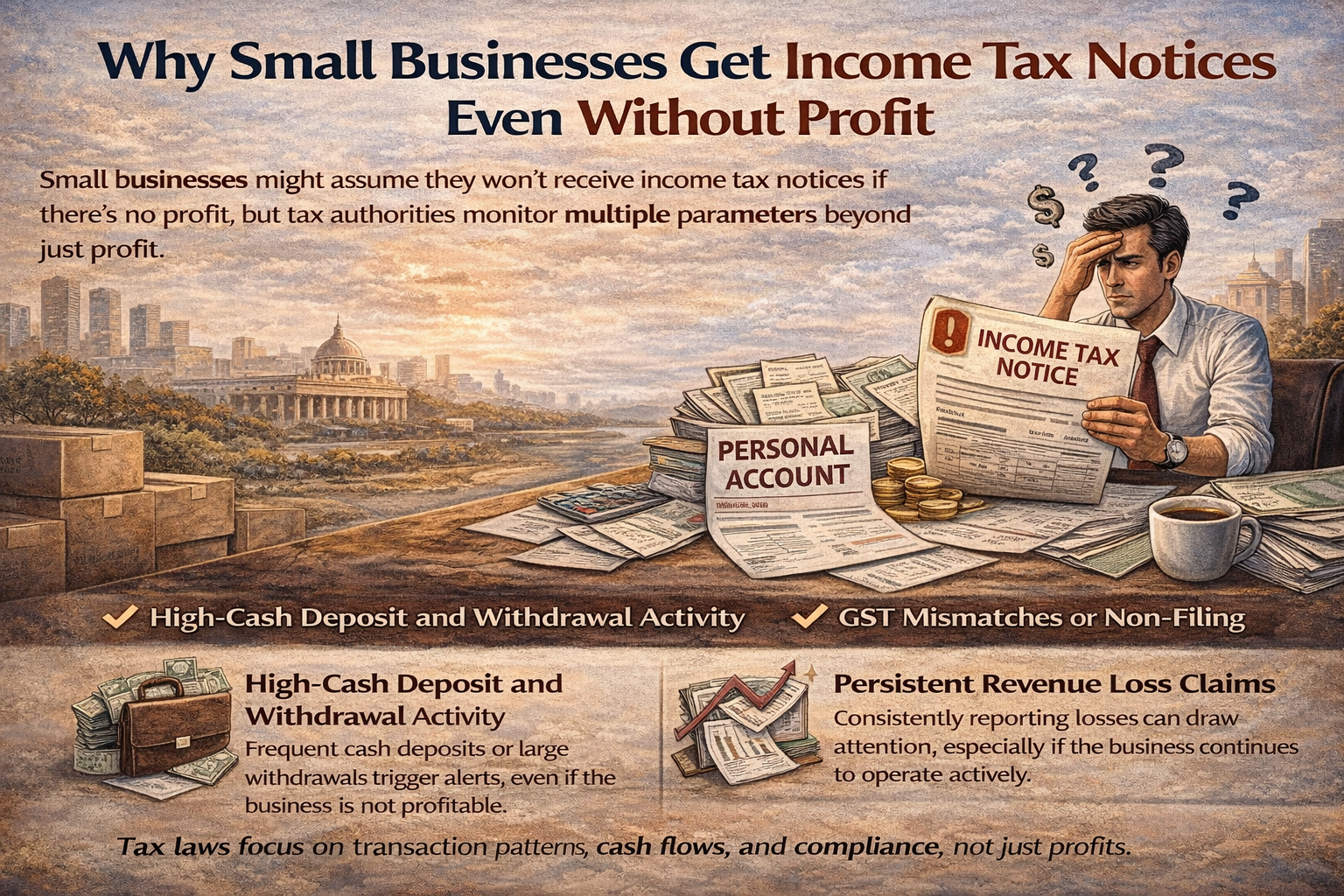
Many small businesses, freelancers, and professionals are surprised when they receive an Income Tax notice even though their business has made no profit or has incurred a loss. This often leads to confusion and unnecessary panic, as taxpayers commonly believe that tax notices are issued only when there is taxable income.
In reality, Income Tax notices are not profit-driven; they are data-driven. The department’s systems focus on information reported from multiple sources and compare it with what is disclosed in the Income Tax Return. Profit or loss is only one part of the picture.
Notices Are Triggered by Data, Not by Profitability
The Income Tax Department collects extensive third-party information related to every PAN. This includes bank transaction data, TDS returns filed by customers, interest income reported by banks, GST filings, and other high-value transactions. All this information is consolidated and matched with the income declared in the return.
If the system detects any inconsistency between this external data and the figures reported in the return, a notice may be generated automatically—even when the final result is a loss.
High Turnover with Low or Nil Profit Raises Questions
A very common reason for notices is a situation where a business reports substantial turnover or bank credits but declares very low profit or a loss. While such cases are commercially possible, the department often seeks clarification to ensure that expenses claimed are genuine and income has not been understated.
For example, a trader may have significant sales but operate on thin margins. If expenses are high and supporting explanations are missing, the return may be flagged for verification. The issue here is not the loss itself, but whether the numbers appear reasonable when viewed alongside transaction data.
AIS Mismatch Is One of the Biggest Reasons
The Annual Information Statement (AIS) has become a major trigger point for notices. It reflects interest income, TDS deductions, sales receipts, and other transactions reported by third parties. Many small businesses either do not check AIS before filing their return or misunderstand its purpose.
When income appearing in AIS is not properly offered to tax or is ignored without explanation, the system detects a mismatch. This often results in notices seeking clarification, regardless of whether the business has made a profit.
TDS Credit Without Corresponding Income Is a Red Flag
Another frequent issue arises when customers deduct TDS and file their returns accordingly. Once TDS is deducted, the department assumes that corresponding income exists. If a taxpayer claims TDS credit but does not report the related income, the system automatically flags the case.
Even if the business has incurred an overall loss, the gross receipts must still be disclosed. Failure to do so is one of the most common reasons why professionals and freelancers receive notices.
Incorrect ITR Form Selection Also Invites Notices
Using the wrong ITR form is a silent but serious mistake. Many small taxpayers file returns using simpler forms without realising that business or professional income requires a different disclosure format.
Incorrect classification of income or use of an inappropriate form may not cause an immediate error, but it often results in system-generated notices later, especially when other data points do not align.
GST and Income Tax Turnover Must Be Consistent
For businesses registered under GST, the department frequently compares turnover reported in GST returns with that declared in the Income Tax Return. Differences are acceptable only when they are properly explained.
When GST returns show higher turnover than the ITR without reconciliation, notices are issued—even if profit margins are low or losses are reported.
Loss Returns Are Scrutinised More Carefully
Contrary to popular belief, loss returns are not ignored. In fact, they are often examined closely to ensure that losses are genuine and not used to suppress taxable income. This is especially true when losses continue year after year or when turnover increases but profitability does not.
Such scrutiny does not mean wrongdoing; it usually means the department is seeking clarity.
What to Do If You Receive Such a Notice
Receiving a notice does not automatically imply penalty or prosecution. Most notices are issued to seek explanations or reconciliations. The key is to read the notice carefully, identify the mismatch pointed out, reconcile data from AIS, bank statements, GST returns, and the ITR, and respond within the prescribed time.
Ignoring a notice or delaying response can turn a simple clarification into a larger issue.
Conclusion
Small businesses often assume that losses protect them from Income Tax scrutiny, but this is a misconception. Notices are primarily issued due to data mismatches, reporting errors, or incomplete disclosures, not because of profitability.
With proper reconciliation, correct reporting, and timely responses, most such notices can be resolved smoothly without escalation.