

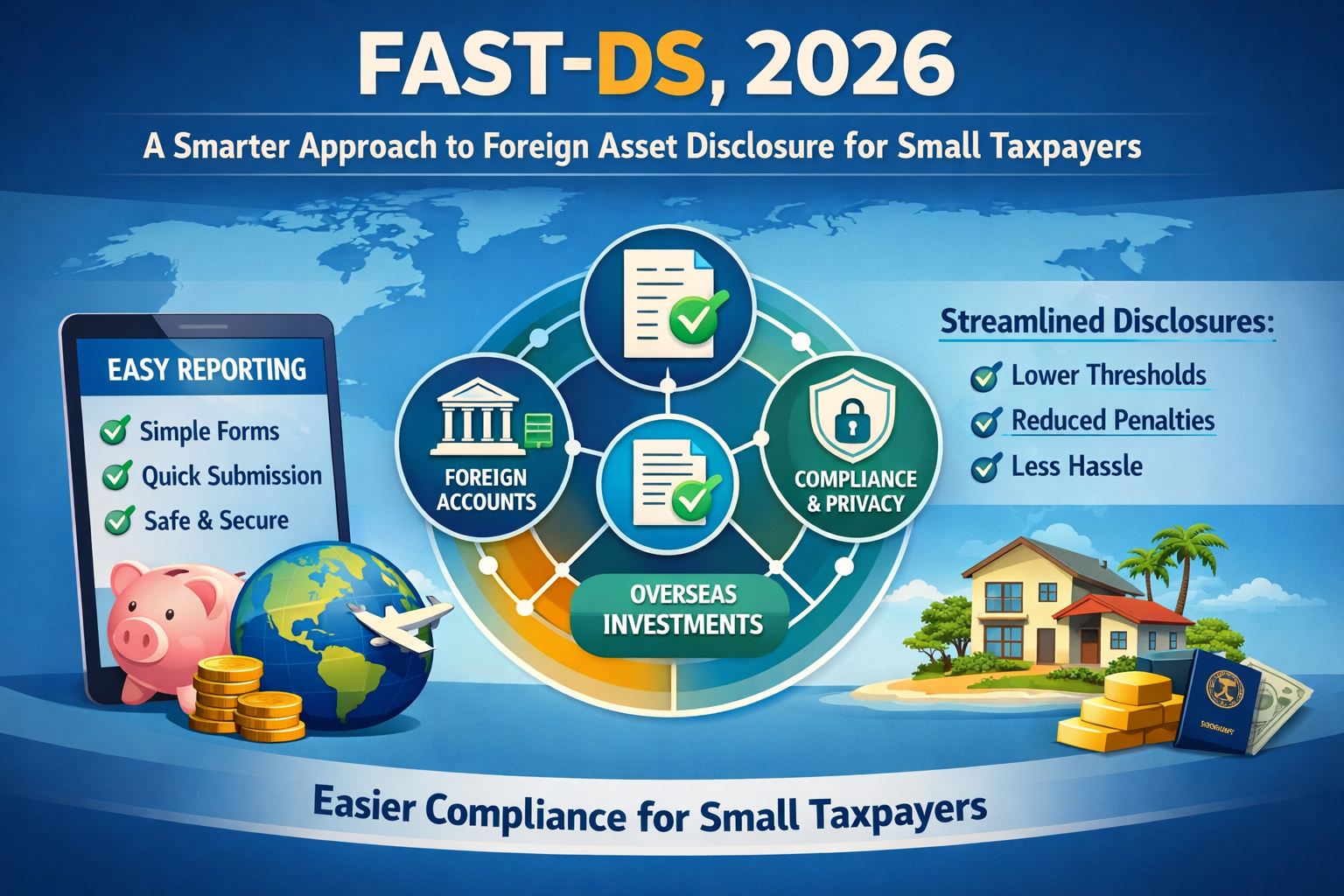
When Tax Law Finally Learns to Count Context
Imagine this number: ₹20 lakh.
Until recently, this amount could trigger foreign asset scrutiny, invite prosecution risk, and haunt students or first-time overseas employees.
FAST-DS, 2026 begins by asking a far better question:
How big is the mistake, really?
That one question reshapes India’s foreign asset enforcement framework.
1. The Problem — A Law That Counted Defaults, Not Impact
Earlier, the tax system recognised only two states: disclosed or not disclosed.
There was no middle ground.
The law never asked:
- Whether the asset was ₹10 lakh or ₹10 crore
- Whether income was already taxed
- Whether the taxpayer was a student or a deliberate evader
As a result, a binary law operated in a graduated world.
2. FAST-DS, 2026 — When Numbers Decide Consequences
FAST-DS does not begin with punishment.
It begins with classification.
There are two categories of defaults:
- Category A: Both income and foreign asset were undisclosed.
- This category applies only if the total value does not exceed ₹1 crore.
- Category B: Income was disclosed and taxed, but the foreign asset was not reported.
- This category applies where the asset value does not exceed ₹5 crore.
The core idea is simple: different mistakes deserve different exits.
3. What Does Compliance Cost Now?
For Category A (Undisclosed Income and Asset), the taxpayer pays tax at 30% along with an additional 30% as a substitute for penalty. The total outflow is 60%, but there is no prosecution risk. The taxpayer exits the system cleanly.
For Category B (Income Tax Paid, Asset Not Declared), where there is no revenue loss to the Government, the law allows closure by paying a one-time compliance fee of ₹1 lakh, with no penalty and no prosecution.
The message is clear: where revenue loss does not exist, criminalisation will not follow.
4. Why FAST-DS Is Not an Amnesty
FAST-DS is not a forgiveness scheme.
It applies only to small taxpayers, has clear monetary thresholds, and imposes a meaningful cost for non-compliance. It is also strictly one-time in nature.
Unlike amnesty schemes that reward non-compliance with discounts, FAST-DS focuses on correction and closure.
5. Who Actually Benefits
FAST-DS is designed for real people with real situations:
- Foreign students with modest overseas bank balances
- Tech employees holding RSUs through foreign brokers
- Returning NRIs with dormant foreign accounts
- Freelancers who earned income abroad but failed to report it
For such taxpayers, FAST-DS offers a defined, proportionate, and litigation-free exit.
6. The Bigger Shift in Enforcement Philosophy
FAST-DS signals a major policy shift:
- From one-rule-fits-all to threshold-based enforcement
- From crime-first to civil-first compliance
- From fear-driven litigation to closure-oriented outcomes
For the first time, numbers—not fear—determine consequences.